It all started as a grassroots gathering of queer film festival programmers at the Prinz Eisenherz bookstore – after the German name for Prince Valiant – in Nolldendorf, Berlin, during the Berlinale. Founded in 1978 as Germany’s first gay bookshop, it still exists and is now just called Buchladen Eisenherz. The idea came up to create an award to be handed out during the Berlin International Film Festival.
So, in 1987, German filmmakers Wieland Speck and Manfred Salzgeber, who died in 1994, co-founded an award for LGBT films and formed a jury, which they dubbed the International Gay & Lesbian Film Festival Association (IGLFFA), to decide the winner. The Teddy Bear Award, echoing the Berlinale’s ursine main awards of the Golden and Silver Bear, was born. Its name was later shortened to Teddy Award, but the statuette remains shaped like a teddy bear.
The first Teddy Award winner was none other than Pedro Almodóvar for Law of Desire (La ley del deseo), starring Antonio Banderas. The list of Teddy winners since then reads like a who’s who of independent filmmaking, including the likes of Todd Haynes, Tilda Swinton, Derek Jarman, Ray Yeung, Céline Sciamma, François Ozon, Christine Vachon, James Franco, Babatunde Apalowo, Ulrike Ottinger, Jay Duplass, Monika Treut, Gus Van Sant, Małgorzata Szumowska, Ira Sachs, Sophie Hyde, Sebastián Lelio, and John Hurt.
Originally focused on films in the Berlinale’s Panorama section, overseen by Salzgeber, in 1992, the Teddy was recognized as an official independent award of the festival. And the honor, celebrating its 40th anniversary this year, has grown into one of the most significant events on the annual queer cinema calendar and inspired other queer film honors.

Todd Haynes with his first Teddy for ‘Poison’ in 1991
The Berlinale is putting a spotlight on the 40th anniversary with the special program “Teddy 40,” which features six short films and eight features from the award’s history, as well as a series of discussions under the moniker “Wild at Heart,” designed to “archive the oral history of the Teddy Award and its far-reaching impact.” Among the topics of debate: “Subversive Reimagining of Cinematic Spaces” and “Embedding Queer Cinema in Industry Structures.”
“Thanks to Manfred Salzgeber and Wieland Speck’s pioneering efforts over 40 years ago, queer cinema, and through it the Teddy Award, have become part of the DNA of the festival,” Michael Stütz, head of the Berlinale’s Panorama section and co-director of film programming, as well as a member of the board of directors of the Teddy Foundation, tells THR. “Born out of the curation, the urgency to champion and make space for queer filmmakers to strive and blossom can be seen throughout all program sections nowadays. Berlin was the ideal festival for it to flourish, with a curious urban audience and enough subcultural spaces back in the 1980s; then press and industry followed.”
And he emphasizes: “Thanks to the dedication of a passionate team and the support of allies throughout the festival and the city, the Teddy is not only part of the Berlinale’s identity but also important to the festival’s special position in the circuit.”
In the early days of Panorama, queer films were rare. “Co-founder Manfred Salzgeber brought them to Berlin and gave them a stage,” recalls Speck, who was his assistant before becoming head of Panorama in 1992 and continuing that role until 2017. “That attracted filmmakers, and in 1987, the selection within the general program was potent enough for us to come up with the Teddy Award. Its purpose: to promote queer film work to an indifferent majority whose homophobia led to marginalization instead of attention.”
Javier Bardem at the Teddy Awards 2007
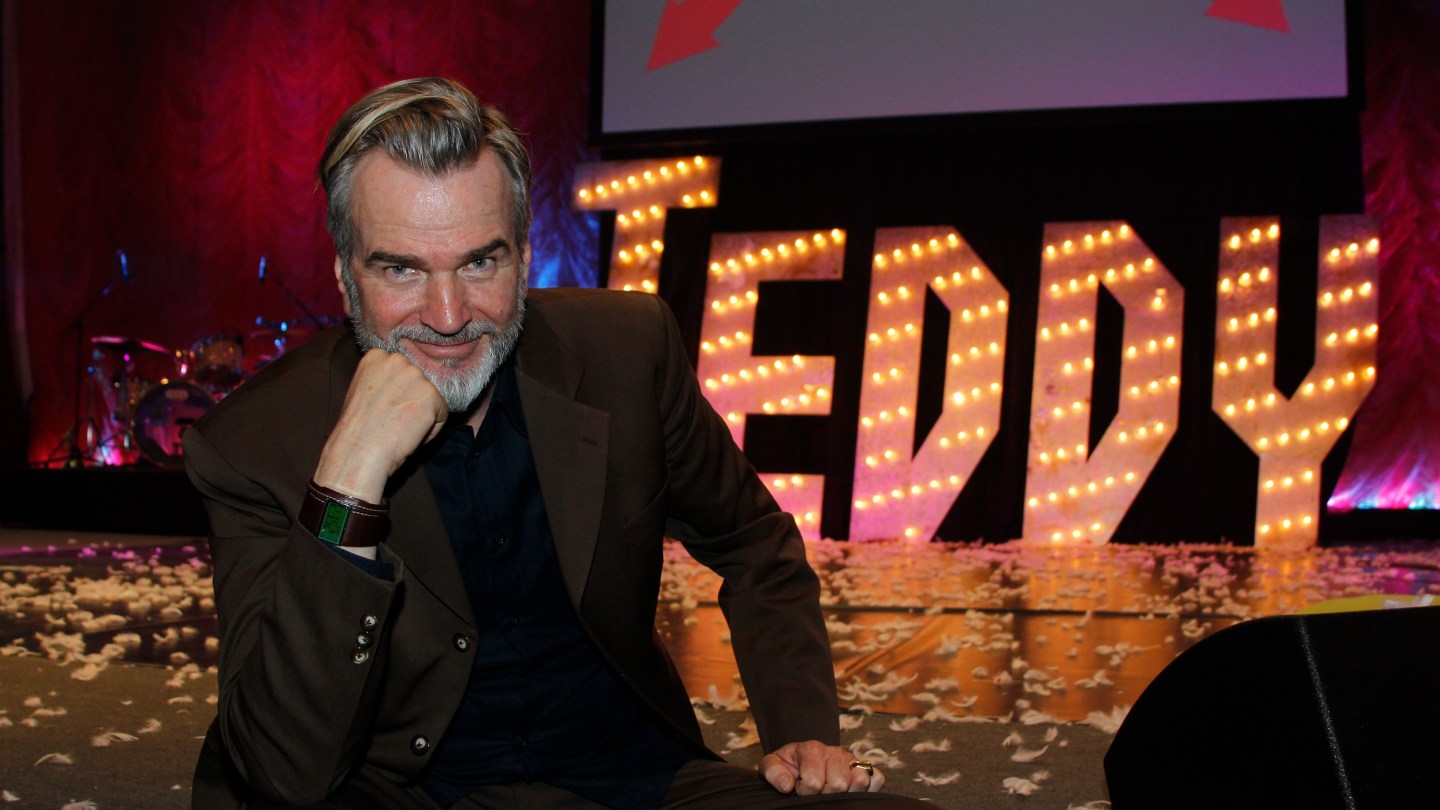
The Teddy ceremonies and parties soon became legendary. Speck recalls taking over famous Berlin locations and “queering them up” for the Teddy celebrations, including the Metropol theater and club, the Tempelhof Airport, and the House of World Cultures. In recent years, the Teddy celebration has been taking over the Volksbühne theater.
The 40th anniversary edition of the Teddy Award Ceremony will take place Feb. 20 at the Volksbühne, with honors presented in the categories best feature film, best documentary/essay film, and best short film, plus a jury award and a special Teddy Award.
The launch of the Teddy was driven by a desire to put a bigger spotlight on queer cinema. “We realized how important it was for filmmakers to win awards, because then the media writes about you,” Speck tells THR. “So we thought, let’s have a queer film award, because we have to also reach beyond the niche of our audience. You know, the people who came to the queer film screenings were basically queer people. And we felt the quality level had become so strong that we had to break out of that niche. So the award was supposed to be one tool to get media attention outside the queer niche.”
About the origin of the name Teddy, he shares: “The Teddy came to me, because, first of all, I had a teddy [bear] when I was a kid. Second, almost everyone had one, and for most people, it was the first companion in bed. Also, when I lived in San Francisco in the late ’70s and went to the Art Institute there, that was the time when the clone was invented by the San Francisco gay population. The clone was this guy with the checkered shirt and a backpack, and on the backpack, most people had a little teddy bear. So that was a sign of solidarity and also of affection, a cuddly thing.”
producer Christine Vachon received the Special Teddy Award in 2016
Finally, “of course, what we have in Berlin is the bear, and the festival gives out the Golden Bear,” Speck highlights. “So, we decided to give out a little teddy.”
The introduction of the Teddy was not without criticism. “Of course, there was general homophobia,” Speck recalls. “But the other negative attitude was, ‘You take away focus from others.’ And as soon as you have visibility, of course, you have new enemies.” But the Teddy Awards ceremony and after party ended up becoming some Berlinale attendees’ favorite night of the fest calendar.
The Teddy also ended up inspiring similar awards over time. “It took more than 10 years, but nevertheless,” Speck tells THR. “Do you know who the first one was to establish something like the Teddy Award? It was the Kyiv International Film Festival Molodist with the Sunny Bunny. It sounds like something you don’t want to hurt and you don’t want to kill. So the Sunny Bunny became the first Teddy outside of Berlin, and now it is awarded at its own festival,” namely the Sunny Bunny Queer Film Festival, Ukraine’s first dedicated LGBTQIA+ fest in Kyiv.
What does Speck expect from the 40th anniversary of the Teddy? “It will be a celebration,” he says. “It will be a thank you to all the people who have worked on [highlighting queer cinema], before and after us. And of Manfred, of course, the central figure, but also many others.”
Teddy Award trophy for best short film in 2016 for ‘Moms on Fire’ by Joanna Rytel
How does he feel about the state of queer cinema and rights amid a global backlash? “Yes, much has changed for the better, in many places of the world – and yet we learn that there is no such thing as a safe space,” so solidarity remains the Teddy’s North Star, concludes Speck. “We will need it now to resist a turning tide that wants to rid us of our achievements – we shall not budge.”
Source link