When dinosaur fossils surface at a site, it is often not possible to tell how many millions of years ago their bones were buried. While the different strata of sedimentary rock represent periods of geologic history frozen in time, accurately dating them or the fossils trapped within them has frequently proven to be frustrating.
Fossilized bones and teeth have been dated with some success before, but that success is inconsistent and depends on the specimens. Both fossilization and the process of sediment turning to rock can alter the bone in ways that interfere with accuracy. While uranium-lead dating is among the most widely used methods for dating materials, it is just an emerging technology when applied to directly dating fossils.
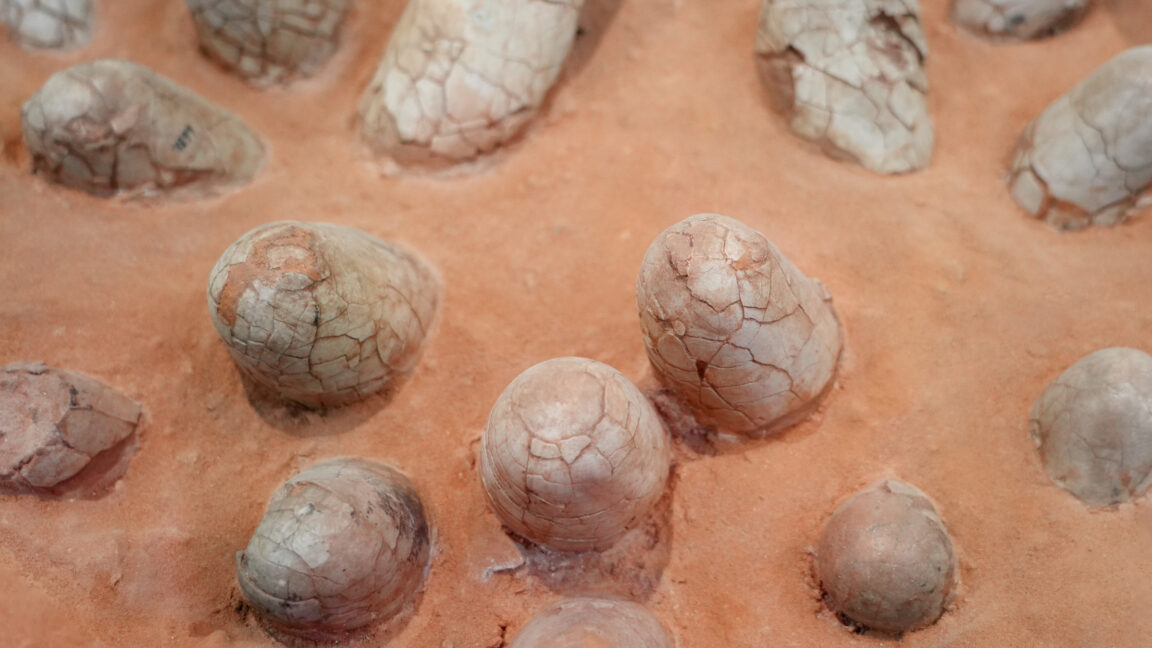
Dinosaur eggshells might have finally cracked a way to date surrounding rocks and fossils. Led by paleontologist Ryan Tucker of Stellenbosch University, a team of researchers has devised a method of dating eggshells that reveals how long ago they were covered in what was once sand, mud, or other sediments. That information will give the burial time of any other fossils embedded in the same layer of rock.
“If validated, this approach could greatly expand the range of continental sedimentary successions amenable to radioisotopic dating,” Tucker said in a study recently published in Nature Communications Earth & Environment.
This goes way back
Vertebrates have been laying calcified eggs for hundreds of millions of years (although the first dinosaur eggs had soft shells). What makes fossil eggshells so useful for figuring out the age of other fossils is the unique microstructure of calcium carbonate found in them. The way its crystals are arranged capture a record of diagenetic changes, or physical and chemical changes that occurred during fossilization. These can include water damage, along with breaks and fissures caused by being compacted between layers of sediment. This makes it easier to screen for these signs when trying to determine how old they are.
Source link