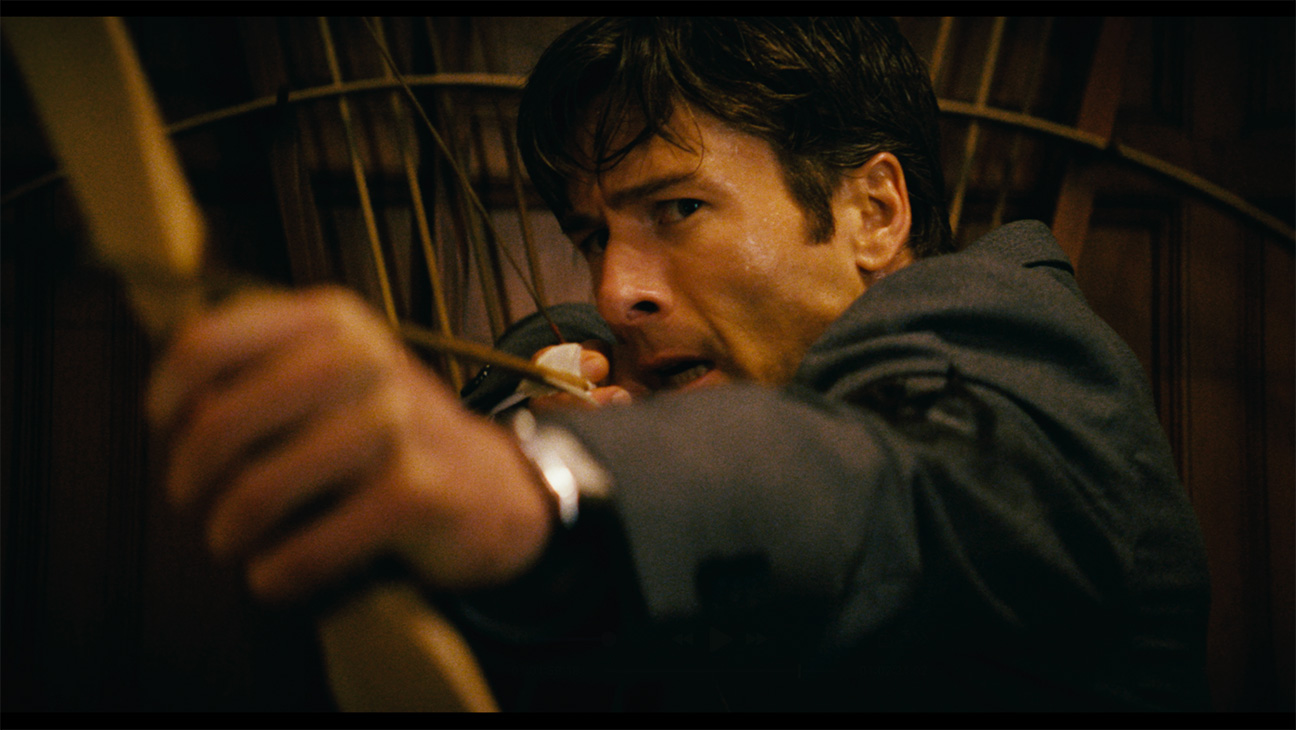
Trying to find your niche as a movie star isn’t easy. Take Glen Powell, for instance, who possesses the sort of matinee idol good looks and charisma that only great genes can provide. Powell has enjoyed great success with continuations of hit franchises, like Top Gun: Maverick and Twisters. And like his not dissimilar predecessor Matthew McConaughey, he’s perfect for romantic comedies, as Anyone but You proved. But he’s also clearly ambitious enough to want to stretch himself. Richard Linklater’s Hit Man, which he also co-wrote, worked beautifully, but that was primarily a streaming release. And when Powell attempted to get into macho leading man mode in the big-budget sci-fi actioner The Running Man, he stumbled badly.
You have to give him credit for again trying something different with John Patton Ford’s How to Make a Killing, loosely inspired by the classic 1949 British comedy Kind Hearts and Coronets. As with that classic film, the central character is a man, disowned by the patriarch of his wealthy family (Ed Harris, given only one real scene to play), who decides to murder all the relatives in the way of his claiming his inheritance. The piece requires a tricky balancing act, since he’s playing a murderer whom you’re expected to root for because he’s, well, Glen Powell.
How to Make a Killing
The Bottom Line
Not dark or funny enough.
Release date: Friday, February 20
Cast: Glen Powell, Margaret Qualley, Jessica Henwick, Bill Camp, Zach Woods, Topher Grace, Ed Harris
Director-screenwriter: John Patton Ford
Rated R,
1 hour 45 minutes
It might have worked if the writer-director and his star had been more willing to go out on a limb. The movie is being promoted as a black comedy, but it’s not very funny. There are times when it attempts to be a serious drama, but we’re not invested enough in the characters for that to work either. Other than the fact that his cutely named protagonist, Becket Redfellow, is killing people who don’t really deserve to die for any reason other than being obnoxious, we’re supposed to identify with him because he’s poor and his victims are rich. I mean, Powell is charming, but he’s not that charming.
The film’s flashback structure revolving around Becket’s death-row conversation with a priest (Adrian Lukis) has its sporadically amusing moments. But it never truly gets dark enough to enjoy as a guilty pleasure. Becket’s killings of his relatives, which mainly involve poisoning of one form or another, are so lacking in impact they seem intended to not make us feel too badly about their perpetrator.
Those casualties, with the exception of Topher Grace amusingly hamming it up as a megachurch preacher who plays electric guitar and proudly shows off his photo with El Chapo, are little more than ciphers. (You start wishing that Alec Guiness could come back from the dead and play all of them, as he did in the original.) And the attempt to give Becket a serious love interest in the form of Ruth (an appealing Jessica Henwick), the widow of one of his victims (not to worry, she was going to leave him anyway), feels perfunctory.
Margaret Qualley, who’s becoming the MVP of many of her pictures, almost makes the film worthwhile. Seeming to enter every scene with her endlessly long legs, she plays Becket’s childhood friend, who comes back into his life and pops up periodically just to energize the proceedings. Portraying the sort of scheming femme fatale who would have made life miserable for any male lead in a film noir, she applies just the right amount of winking humor to the material while Powell, playing it totally straight, seems like a deer caught in the headlights.
The other highlight is the performance by the ever-reliable character actor Bill Camp, as Becket’s only decent relative, who takes him under his wing and whom he can’t bring himself to kill. Camp brings real heart and tenderness to his scenes, making the way his character’s arc is resolved feel like a cheat.
Ultimately How to Make a Killing doesn’t have the courage of its convictions, or even its killings, giving it a blandness that’s surprising coming from the writer-director of the much sharper Emily the Criminal, a similarly themed, darkly tinged thriller in which its star Aubrey Plaza displayed a fearlessness that is sorely lacking here.
Source link